Monday, May 18, 2015

Coral Snake. Many Habitat in US

Coral Snake Appearance
There are many varieties of coral snakes throughout the Americas, but we will address the USA snakes. The most common species in the United States have a universal red-yellow-black-yellow pattern. Not all coral snakes have the same color scheme, so it is important to be familiar with the snakes specific to your region. This snake is small in comparison to other venomous snakes in the United States. At its longest, an adult can measure around thirty inches. The colorful body is slender and lacks real variance in width. The head blends seamlessly into the body with no distinctive neck. The head of this species of coral snake is always black. 

Coral Snake Habitat and Behavior
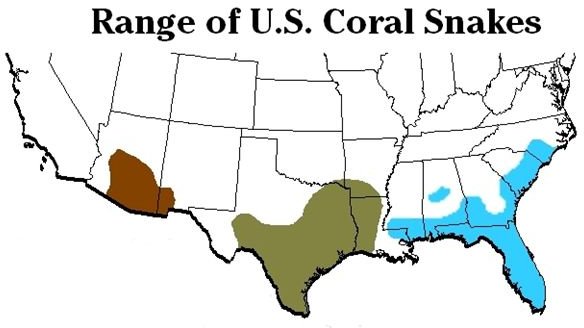
There are two types, the Eastern Coral Snake, and the Western Coral Snake. The Eastern is more common, but neither is seen often, because Coral snakes that live in either the southeastern or southwestern United States prefer wooded, marshy, and loose-soiled areas often under debris. They
are very reclusive, staying in the safety of underground burrows or dens during the day and emerging in the evening and early morning to feed. Among their own kind, coral snakes are solitary, showing aggression even during breeding.

Unlike other venomous snakes, the coral snake has round pupils, a blunt head, and no heat sensing pits. Its venom sacks are not attached to the fangs but are adjacent to the teeth, permeating the puncture holes as the snake latches onto a victim. Contrary to common belief, the maximum amount of venom can be delivered without chewing; the venom delivery is related to the duration of time the snake is attached, not how many times it bites its prey. Multiple bites do facilitate quicker venom transfer, but do not necessarily affect the quantity. 

Coral snake venom is neurotoxic, another fact which distinguishes it from other North American poisonous snakes. Neurotoxic venom affects the way the brain communicates with muscles, slurring speech, affecting movement, and ultimately ceasing cardiac or respiratory function. A bite from a coral snake can go without symptoms for as long as twelve hours. 

Unfortunately, due to their bright colors, coral snakes are a favorite of children. Many of the reported bite cases are due to the curiosity of a young person who tried to pick up the reptile. For this reason, it is good that coral snakes are shy and rarely spotted. To avoid trouble, read more about the Snake Rhyme Poem, and information about the Coral Snake Look Alikes, such as the Scarlet Kingsnake, to find out what does a coral snake look like. 

Infant coral snakes hatch from eggs laid by the female snake. Coral snakes do not give birth to live young like many of the other North American venomous snakes. Once born, coral snakes are seven inches long and are already at their full venomous potential. 

Coral Snake Diet


Coral snakes are carnivorous and like a diet of other reptiles and snakes (even other coral snakes). It will occasionally feed on frogs. 

Coral Snake Facts:

  • Coral snakes are often confused with some non-venomous snakes of similar coloration. The milk snake and scarlet kingsnake have similar colors but in different patterns.
  • Coral snakes are the only venomous snake in North America that is not a pit viper.
  • Coral snakes are related to mambas, cobras, and sea snakes.
  • A variety of rhymes have been developed to properly identify a coral snake. “Red on yellow, kill a fellow. Red on black, friend of Jack” is just one variation.
  • No deaths from a coral snake bite have been reported since 1967 when the antivenin was developed.
  • The life expectancy of a coral snake in the wild is unknown. In captivity, the snakes will live as long as seven years.
  • The fangs of the coral snake cannot be flatted against the roof of the mouth. They are permanently erect.
  • Coral snakes around the world come in all varieties of colors from blue and red to black with bright yellow spots.
  • Coral snakes are named for the bright, underwater coral explorers discovered along the coasts of the New World.
  • When it is threatened, the coral snake will curl up, using its tail in an attempt to confuse the attacker as to which end of the snake is the actual head.

Fact About Banded Water Snake


Banded Water Snake Biology
The banded water snake also known as the Nerodia Fasciata Fasciata is one of the types of snakes that you rarely see. In the southern area of North America is mostly where these snakes are found. Over time, they have adopted many scientific names such as Natrix Sipedon Fasciata, Tropidonotous
Fasciatus, and Coluber Fasciatus. These snakes can grow up to over 40 inches long and they appear as reddish brown or deep brown. Their bellies are yellow in color with red or black spots that are bright enough to be noticed. However, their skin may become darker with age. These snakes often have cross bands on their backs and sides. Some of them are wider while others are narrower. They are keeled, heavy bodied and often lose their banding as they age. 

Habitat
Because these snakes are not known for eating other snakes, they can be put together in groups or with other snakes. They typically enjoy living in freshwater areas like the marshes, lakes, streams, rivers and ponds and are found in the southern area of North America. They can sometimes be found on land, hanging from tree branches and even though they are not very attractive pets, being held captive is not a problem for them. While these snakes are very common in many places especially Florida, they are not very protected either. 

Behavior
Their disposition is quite nasty but they are quite easy to care for if you wanted to take one home to have as a pet. This type of snake will normally flee at the sign of trouble. However, it does not always work out that way. In this case, they will bite and release an irritating musk if they feel threatened. Otherwise, they can live quite comfortably amongst humans or other animals. Avoid picking these snakes up because they will take offense and strike. In some cases, you will find water snakes that will eat food from your hand. However, this is not a chance that you would want to take. These snakes can be found in the day or the night time. However, they are more active at night. 

Diet
Speaking of rodents, if you have a problem with them on your property, a banded water snake will certainly devour them for you. The water snake is always active so they do not eat very much food all at the same time. They may go days without eating. You can expect their diet to consist of tadpoles, crayfish, salamanders, small fishes and frogs. 

Reproductive
Close to the end of the summer months you can expect these snakes to have about 25 or more babies. In fact, it was reported about 10 years ago that one actually had 44 babies in the late months of the summer. This is the most that has been recorded so far. Their babies are known to appear as a bright 8 inches long patterned snake. These snakes are live bearers and their babies have no problem with breeding in a captive environment. Just like their parents, they will strike when they feel in danger and the development of their musk glands is complete when born. They begin mating in the spring and have their children during the summer. 

More Interesting Facts
The banded water snake is often mistaken as the cottonmouth snake or a moccasin which is venomous but appears very similar to the banded water snake. The only real way to tell them apart is by paying attention to their behavior. A banded water snake does not open its mouth wide in an attempt to attack when feeling danger is near. Also, the banded water snake does not find it amusing to switch its tail when it feels somewhat disturbed like the cottonmouth snake does. 

Knowing the differences between these snakes is very important considering it could save you a trip to the hospital. These snakes are found in the same places and often eat some of the same things. It can be very hard to notice the difference until you get close to them and pay close attention to their behavior. 

Sunday, May 17, 2015

Fable of Snake

A Greek writer named Aesop wrote many stories called fables.  Fables are stories that are told in order to teach a lesson.  They aren’t necessarily true.  Aesop wrote the following stories about snakes.  The moral, or lesson, of the story is at the end. Here are some examples:

The Laborer and the Snake

A snake, having made his hole close to the porch of a cottage, inflicted a mortal bite on the cottager's infant son. Grieving over his loss, the father resolved to kill the snake.  The next day, when it came out of its hole for food, he took up his axe, but by swinging too hastily, missed its head and cut off only the end of its tail.  After some time the cottager, afraid that the snake would bite him also, endeavored to make peace, and placed some bread and salt in the hole.  The snake, slightly hissing, said: "There can henceforth be no peace between us; for whenever I see you I shall remember the loss of my tail, and whenever you see me you will be thinking of the death of your son."

The lesson: No one truly forgets injuries in the presence of him who caused the injury.

The Farmer and the Snake

One winter a farmer found a snake stiff and frozen with cold. He had compassion on it, and taking it up, placed it in his bosom.  The warmth quickly revived the Snake, and resuming its natural instincts, bit its benefactor, inflicting on him a mortal wound. "Oh," cried the farmer with his last breath, "I am rightly served for pitying a scoundrel."

The lesson: The greatest kindness will not bind the ungrateful.

The Serpent and the Eagle

An Eagle swooped down upon a Serpent and seized it in his talons with the intention of carrying it off and devouring it.  But the Serpent was too quick for him and had its coils round him in a moment; and then there ensued a life-and-death struggle between the two.  A countryman, who was a witness of the encounter, came to the assistance of the eagle, and succeeded in freeing him from the Serpent and enabling him to escape.  In revenge, the Serpent spat some of his poison into the man's drinking-horn.  Heated with his exertions, the man was about to slake his thirst with a draught from the horn, when the Eagle knocked it out of his hand, and spilled its contents upon the ground.


The lesson: One good turn deserves another.  

Myth and Snake Story

All through history snakes have been both good and evil.  Here are some historic examples:

In the Christian bible, the story of Adam and Eve being tempted by the evil snake.  It was the snake (Satan) the tempted Eve with an apple and caused them to be kicked out of the beautiful Garden of Eden.  Also in the Bible, Moses, who went to Egypt to convince the Pharaoh to release the Hebrew slaves, turned his staff (walking stick) into a snake to prove God’s power.


The Ancient Aztecs worshipped the snake. Quetzalcoatl was the “plumed serpent” and was considered the “Master of Life”.

Some African Cultures worshipped rock Pythons and killing a python was a very serious crime.
Aborigines in Australia believed that a giant rainbow serpent was the creator of life.

Many cultures believed that snakes had medicinal or healing powers.

And of course there is the story of St. Patrick who got rid of all the snakes in Ireland.  He is celebrated every year on March 17th.  Supposedly there are no snakes in Ireland to this day.

What about the stories of the snake charmers? Where the charmer plays the flute and the snake slowly comes out of a basket and sways to the music.  Since snakes cannot hear sounds that aren’t vibrating on the ground, they can’t hear the flute music.  The snake is actually following the motion of the flute and usually the charmer is swaying back and forth as well.  The snakes that charmers use are tired out before hand so that they don’t attack the charmer.

Some common snake myths:
  • The Death Adder has a sting in its tail.
  • Snakes hypnotize their prey. 
  • Tiger Snakes chase people. 
  • Snakes milk cows. 
  • If you kill one of a pair of Tiger Snakes, its mate will hunt you down to take its revenge.
  • In Australia, there is a Hoop Snake that takes its tail in its mouth and then goes bowling merrily along.

A Greek writer named Aesop wrote many stories called fables.  Fables are stories that are told in order to teach a lesson.  They aren’t necessarily true.  Aesop wrote the following stories about snakes.